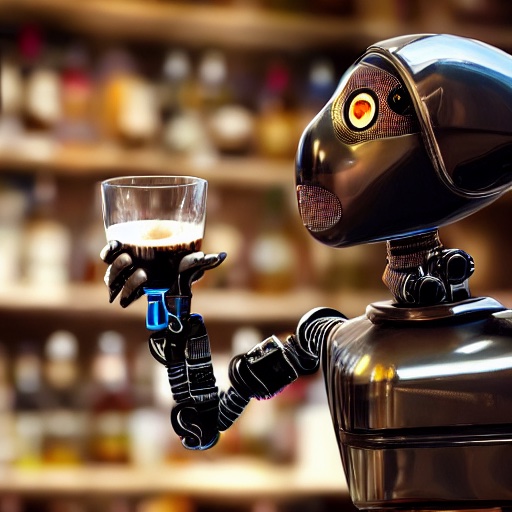
Official release sample
CompVis / Stability AI
Aug 2022 · txt2img
One of the text-to-image samples shipped in the CompVis/stable-diffusion README at release.
Stable Diffusion 1.4
CompVis (LMU Munich) · Stability AI · Runway
On August 22, 2022, Stability AI put the weights of Stable Diffusion v1.4 on the open internet — code, model, and a permissive CreativeML OpenRAIL-M license that allowed commercial use — after a researcher-only release earlier in the month. It is the single most consequential release on this timeline before the video models arrived, and the reason the video models arrived the way they did. The model came out of the CompVis group at LMU Munich, where Robin Rombach, Andreas Blattmann, Dominik Lorenz, Patrick Esser, and Björn Ommer had published "High-Resolution Image Synthesis with Latent Diffusion Models" at CVPR 2022. The trick was to run diffusion not on pixels but in a compressed latent space, which is what let an 860-million-parameter U-Net with a 123-million-parameter CLIP ViT-L/14 text encoder generate 512×512 images on a consumer graphics card. Development was led by Esser at Runway and Rombach at CompVis; Stability AI paid for the compute — 256 A100s, about 150,000 GPU-hours, roughly $600,000 — on data assembled by the German nonprofit LAION, with EleutherAI credited as well. Version 1.4 was 1.2 fine-tuned for a further 225,000 steps on LAION-Aesthetics v2 5+, and at release it needed about 7 GB of VRAM; within months, optimized builds ran in under 3 GB. That last number is the whole story. DALL·E 2 had arrived in April and Midjourney in July, both closed, both metered, both watched. Stable Diffusion could be downloaded, run offline, fine-tuned, dissected, and bolted onto anything. Emad Mostaque framed it as ending corporate control over image synthesis and put the ethics on the user: it is "peoples' responsibility as to whether they are ethical, moral, and legal in how they operate this technology." The consequences came fast in both directions. The AUTOMATIC1111 web UI appeared within the week; DreamBooth, textual inversion, and a thousand community checkpoints within the month; Runway shipped 1.5 on October 20 — with a public dispute with Stability over who had the right to — and 2.0 followed in November. The Washington Post ran "Ready or not, mass video deepfakes are coming" eight days after release. Getty Images and a class of artists led by Sarah Andersen sued Stability in January 2023, the first major copyright litigation over generative AI. For filmmakers the release matters because of what shipped in the box beside txt2img: img2img. Image in, prompt-guided image out, with a strength dial. Feed it a frame, take the output, nudge it, feed it back, and you have animation — the DeepDream loop again, but with a text prompt at the wheel. Within weeks the Deforum notebook had turned that loop into a proper animation tool with 2D and 3D camera moves, and a generation of creators spent the winter of 2022–23 making the flickering, morphing zoom videos that are this timeline's first real era of AI motion. ControlNet, AnimateDiff, and Stable Video Diffusion all grew directly out of this codebase. Every open-weight video model since — Wan, Hunyuan, LTX, Mochi — is following a path Stable Diffusion 1.4 cleared: release the weights, and let the community find out what the model is for.