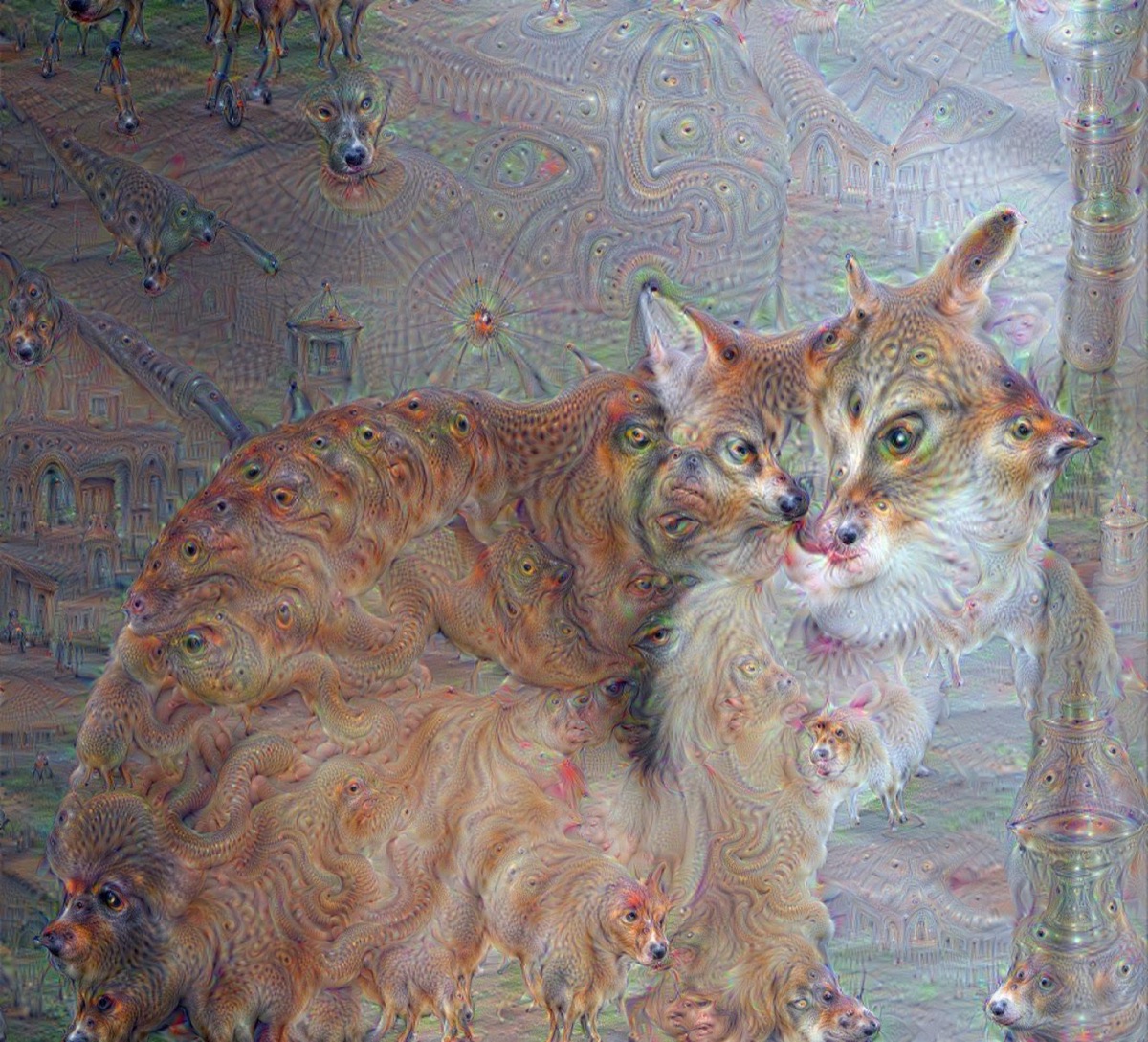
Father Cat
Alexander Mordvintsev
May 26, 2015
One of the first DeepDream images. Via Artnome / AIArtists.org.
DeepDream
Alexander Mordvintsev / Google
In June 2015 Google published Inceptionism: Going Deeper into Neural Networks, and the internet met DeepDream — the psychedelic, dog-eyed images that saturated the culture that summer and then vanished. The images that started it all were made a month earlier: a cat, a custard apple, a portrait of the artist's father, generated in May 2015 and sitting unseen on a drive until Alexander Mordvintsev found them in late 2018 and Google released them under Creative Commons. They were ahead of their time, which is why this entry sits at the head of the timeline. The origin story is now folklore. Mordvintsev, a Google engineer in Zurich who had joined the company the year before, woke from a nightmare at 2:00 AM on May 18, 2015 and decided to try an experiment he'd been carrying around for a while. He was after image super-resolution. What he got instead came from running a classifier backwards: "Neural networks are systems designed for classifying images. I'm trying to make it do things it is not designed for, like detect some traces of patterns it is trained to recognize and then trying to amplify them." Feed a photo into Google's Inception network, ask it what it half-sees, and nudge the pixels so it sees more of it. Repeat. He posted the result to an internal Google board and went back to sleep. Because the network was trained on ImageNet, with 120 dog breeds among its categories, everything it dreamed came out canine — eyes, snouts, and the slug-dog hybrids that became the look. Google published "Inceptionism" on June 17 with colleagues Chris Olah and Mike Tyka; the code went open-source in July; within weeks there were apps, a Foster the People music video, and a psychedelic aesthetic everyone had seen and nobody could unsee. The connection to video is the part that matters here, and it was there from the first month. DeepDream is an iterative process — the jellyfish sequence in the slideshow shows the same photo at ten and fifty passes — and iteration is animation. Run it on a frame, zoom in a little, hand the result back to the network, repeat: the "DeepDream zoom" was born within days of the code release, and Johan Nordberg's July 12, 2015 "Inside an Artificial Brain" — five minutes of static resolving into creatures, one network layer at a time — is a direct ancestor of every AI zoom video, every Disco Diffusion animation, and the entire 2021–2022 era of frame-by-frame generative motion on this timeline. It was the first time a neural network's imagination had been made to move, and the first time a mass audience watched it happen. Two years before, Mordvintsev's hallucinations were being shown as art; six years later, on the algorithm's anniversary, he rewrote it in 900 lines of C89 as "deepdream.c" so it could still be run a century from now. Mordvintsev didn't consider himself an artist in 2015 and treated the images as byproducts. "A lot of people have told me that they got into machine learning and computer vision as a result of seeing DeepDream," he later said. Mario Klingemann was one of them. So, arguably, was the field.